NH 35, Sector PHI-3, Near Honda Chowk & Prateek Residency, Greater Noida, U.P. 201308, India
Call: +91-9555 6640 40
Email: info@crhemd.com
Blog
Headphones and earphones have become part of everyday life. We use them for office calls, online classes, gaming, music, meetings, and travel. For many people in the metro cities, headphones remain in their ears for several hours each day.
The convenience is undeniable. However, listening at a high volume for long periods can put your hearing at risk.
At CRH ENT MRI & Diagnostics, Greater Noida, patients often consult our ENT specialists for ear discomfort, ringing in the ears, reduced hearing, or a blocked-ear feeling. In some cases, prolonged exposure to loud sound through headphones or earphones may be contributing to these complaints.
The good news is that you do not necessarily have to stop using headphones. What matters more is how loudly and how long you use them.
Yes. Repeated exposure to loud sound can damage the delicate structures involved in hearing.
Inside the inner ear is the cochlea, which contains tiny sensory hair cells. These cells help convert sound vibrations into signals that the brain understands as sound.
Excessively loud noise can injure these cells. Unlike many other cells in the body, damaged inner-ear hair cells do not readily regenerate in humans. Therefore, repeated harmful noise exposure can lead to permanent noise-induced hearing loss.
The risk does not depend only on whether you use expensive or inexpensive headphones. Volume and duration of exposure are particularly important.
People sometimes ask whether a particular headphone or earphone brand is safer for their ears. There is no simple answer based on brand alone.
Even good-quality headphones can become harmful when music is played too loudly for too long.
Similarly, someone working in a call centre or attending online classes may need headphones for several hours. In such situations, listening breaks and sensible volume levels become especially important.
A useful principle is simple:
The louder the sound, the less time your ears should be exposed to it.
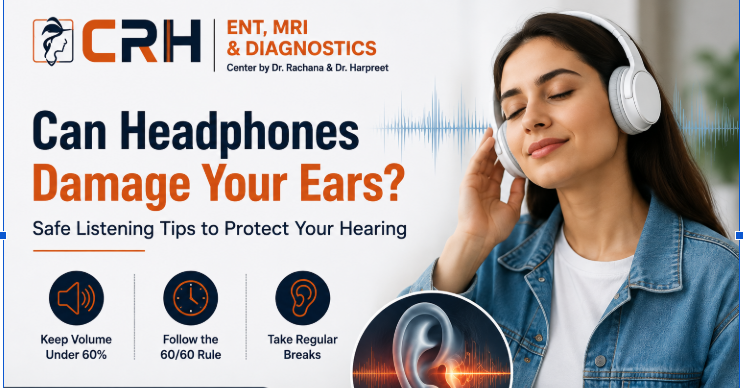
One practical listening habit often discussed for personal audio devices is the 60/60 rule.
Try to keep your headphone volume around 60% or below of the device's maximum volume and take a listening break after about 60 minutes.
The 60% figure is only a practical rule of thumb. Actual sound exposure can vary significantly between devices, headphones, recordings, and environments.
Therefore, avoid treating 60% as a guaranteed safe threshold.
After prolonged headphone use, remove your headphones and allow your ears some quiet time. Even a 10–15 minute break can be a useful habit before you start listening again.
For people who depend on headphones for work or study, regular breaks are more practical than trying to set one fixed daily limit.
Hearing damage does not always begin with obvious hearing loss. Early symptoms can be easy to dismiss.
Pay attention if you experience:
Ringing, buzzing, or whistling in the ears
Ear pain after using headphones
A blocked or full sensation in the ear
Difficulty understanding conversations
Needing to increase the television or phone volume
Sounds appearing muffled after removing headphones
Increased sensitivity to certain sounds
Difficulty hearing clearly in crowded places
If these symptoms repeatedly appear after headphone use, reducing your listening exposure is sensible. Persistent or worsening symptoms should be assessed by an ENT Doctor in Greater Noida or a qualified hearing professional.
A Typical Case: When Daily Headphone Use Starts Affecting Hearing
Consider a common situation we see in modern ENT practice.
A young working professional uses headphones for online meetings, calls, and music. His headphones remain on for six to eight hours on busy days. Because he works around background noise, he gradually increases the volume.
After several months, he notices ringing in his ears after work. Soon, conversations in crowded places become harder to follow. His ears sometimes feel blocked after removing the headset.
At first, he assumes the headphones themselves are faulty.
However, an ENT evaluation suggests that prolonged sound exposure is the bigger concern.
The solution starts with understanding his listening habits. Volume is reduced, regular listening breaks are introduced, and unnecessary headphone use is avoided. Where symptoms indicate a possible hearing problem, appropriate ear examination and hearing tests help determine whether any measurable hearing loss is present.
This example shows why early assessment matters. Waiting until hearing becomes noticeably poor may allow avoidable damage to progress.
How Do ENT Specialists Check Headphone-Related Hearing Problems?
If you visit CRH ENT MRI & Diagnostics with hearing difficulty, tinnitus, ear pain, or a blocked-ear sensation, the first step is to identify the actual cause.
Not every hearing problem is caused by headphones.
Earwax, middle-ear infection, eardrum problems, age-related hearing changes, and several other conditions can produce similar symptoms.
Depending on your symptoms, your ENT specialist may recommend an ear examination and appropriate hearing assessment. Further investigations are advised only when clinically required.
This is why searching for remedies online should not replace a proper diagnosis when symptoms persist.
Patients frequently ask whether headphones are safer than earbuds.
Neither type is automatically safe or unsafe.
The key factors remain sound level, listening duration, fit, and environment. If outside noise forces you to continually increase the volume, your overall sound exposure may become higher.
Well-fitting headphones and effective noise reduction can sometimes help users hear clearly without turning the volume up excessively. However, safe listening habits remain essential regardless of the device.
You do not have to give up your headphones. Instead, change the way you use them.
Keep the volume moderate. Take regular breaks during long work or study sessions. Avoid turning the volume up simply to overpower traffic, gym music, or other background noise.
Also, give your ears quiet periods during the day. If you notice ringing or muffled hearing after listening, treat it as a warning rather than simply increasing the volume next time.
Most importantly, do not ignore persistent hearing changes.
Book an ENT consultation if ringing, hearing difficulty, ear pain, or a blocked sensation persists or keeps returning.
Sudden hearing loss in one or both ears requires urgent medical assessment. Do not wait several days to see whether it improves on its own.
Patients looking for an ENT Doctor in Greater Noida can visit CRH ENT MRI & Diagnostics for evaluation of ear infections, tinnitus, hearing problems, vertigo, and other ear, nose, and throat conditions.
You can also explore our related ENT services, hearing assessment, hearing treatment, vertigo treatment, and ENT Hospital in Greater Noida pages for further information.
CRH ENT MRI & Diagnostics provides specialist ENT care for patients from Greater Noida, Pari Chowk, Knowledge Park, Alpha, Beta, Gamma, Delta, Noida Extension, Noida, Ghaziabad, and Delhi NCR.
Our ENT team evaluates the cause of hearing problems before recommending treatment. This is especially important because symptoms that appear to be caused by headphones can sometimes have another underlying cause.
Reviewed by ENT Specialists at CRH ENT MRI & Diagnostics
This article is based on guidance discussed with the ENT team at CRH ENT MRI & Diagnostics, Greater Noida and general safe-listening principles. Our experienced ENT specialists manage ear infections, hearing disorders, tinnitus, vertigo, and other ENT conditions using clinical evaluation and appropriate diagnostic testing.
Can using headphones every day damage hearing?
Daily use does not automatically cause hearing loss. However, listening at high volumes for prolonged periods increases the risk of noise-related hearing damage.
Is 60% headphone volume safe?
Keeping volume around or below 60% is a useful practical guideline, but it is not an exact safety threshold. Actual sound output differs between devices and headphones.
How long should I use headphones continuously?
For prolonged listening, take regular breaks. A practical habit is to pause after around 60 minutes and give your ears 10–15 minutes away from headphones before continuing.
Can headphones cause tinnitus?
Exposure to loud sound can trigger or worsen tinnitus in some people. Persistent ringing or buzzing should be evaluated by an ENT specialist.
Are expensive headphones safer for hearing?
Not necessarily. Headphone price or brand alone does not determine hearing safety. Listening volume and duration are major factors.
Can headphone-related hearing loss be reversed?
Temporary muffled hearing after loud sound may improve, but permanent noise-induced damage may not be reversible. Prevention and early assessment are therefore important.